Millions of Americans Blame "Old Age" for Their Stiff, Aching Joints. Doctors Watch a Number Most of Them Have Never Checked.
It shows up on routine bloodwork. Emergency rooms treat it as a warning light. And a growing body of research suggests it may be connected to far more than the occasional flare-up in your big toe.
If you are over 50, you probably know the routine by heart. Hands that need a few minutes to "wake up" in the morning. Knees that make you think twice about the stairs. Fingers that ache when the weather turns. A body that seems to negotiate with you before every walk, every garden bed, every grandchild lifted off the floor.
And you probably know the explanation by heart too: wear and tear. Getting older. Something you learn to live with.
But researchers who study the chemistry of inflammation keep circling back to a different suspect. Not your age. Not your mattress. A single compound your own body produces every day: uric acid.
The Number Doctors Watch When Things Get Serious
Most people only know uric acid as "the gout thing." That reputation undersells it badly.
In emergency and intensive care medicine, serum uric acid is treated as a warning light. Studies of critically ill patients have found that elevated uric acid levels track with significantly worse outcomes, which is part of why doctors check it when the stakes are high. Yet outside the hospital, most of us never look at ours, and never connect it to how our joints feel day to day.
Here is the connection researchers find interesting. When your body produces uric acid, the same chemical reaction also throws off unstable molecules called free radicals. So the more uric acid your body is churning out, the more oxidative stress it may be dealing with at the same time. And oxidative stress and inflammation travel together. Elevated uric acid levels have been associated in research with higher levels of inflammatory markers throughout the body.
In other words: the compound famous for one sore toe may be tied up with the same inflammation story playing out in your hands, knees, shoulders, and back.
The "Sandpaper" Problem
Where does all that uric acid go? When levels run high for long enough, it can migrate out of the blood and settle in and around the joints, where it can form microscopic, needle-like crystals.
One phytotherapist who spent years studying the problem described those crystals as "sandpaper, literally grinding at the joint." It usually starts at the extremities, the big toe being the classic example, and can work its way up from there.
He also cataloged a set of early signals that many people brush off:
- A sharp, sudden twinge in the wrist, elbow, or shoulder when picking something up
- Frequent neck spasms that keep sending you back to the chiropractor
- Swollen ankles at the end of the day, as the body retains water trying to dilute the acid
- An odd one: squeeze your earlobe. If it feels tender or achy, he considered it a sign levels may be creeping up
None of these prove anything on their own. But together they sketch a picture of a body working overtime against a rising acid load. Which raises the obvious question: what do you do about it?
The Advice Everyone Gets (And Why It Wears People Down)
If you have ever asked a doctor about uric acid, you already know the standard answer: change your diet. No red meat. No shellfish. Watch the beer and the wine. Skip half the foods that make a Sunday dinner worth sitting down for.
It is not wrong, exactly. Diet matters. But for most people it is miserable to sustain, and even those who follow it faithfully often find the stiffness and the flare-ups still come. Your body produces uric acid on its own, every single day, whether or not you touched the shrimp. Cutting foods can lower the input. It does nothing to help your body process and clear what it is already making.
That gap, between restriction that punishes you and support that actually helps the body do its job, is exactly where one plant-medicine specialist went looking for an answer.
The Phytotherapist Who Refused to Just Mask It
That phytotherapist was Vincent Tones, a South African plant-medicine specialist with a personal stake in the problem. He suffered from gout himself. His wife struggled with wrist and tendon trouble that made everyday tasks miserable. And everything on the pharmacy shelf seemed built to quiet the symptom while ignoring the source.
"We tried to get a product that was there not just to help repair the joint, but actually get rid of the cause," he later explained in a television interview. The cause, as he saw it, was uric acid crystallizing in the joints.
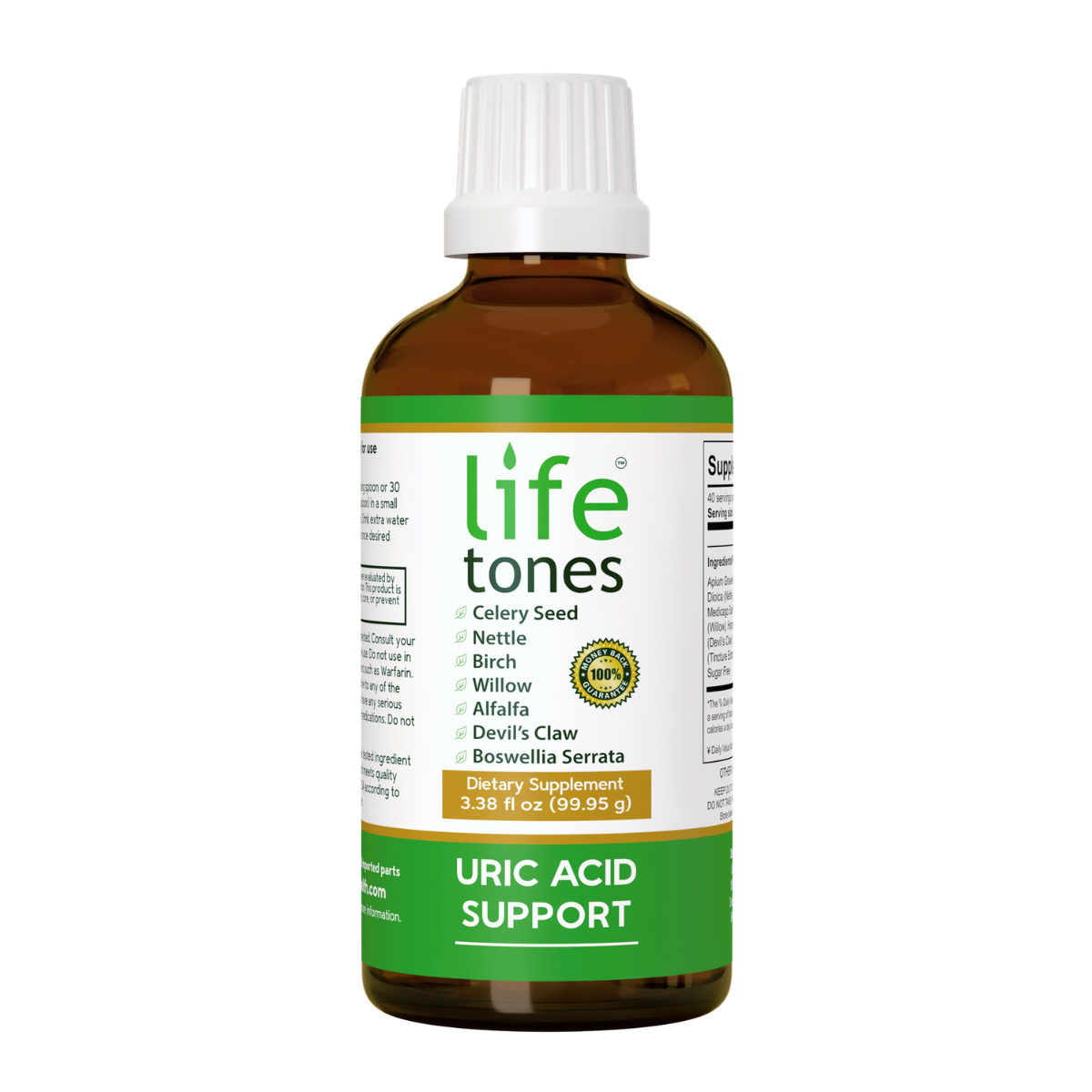
So he and his wife formulated their own answer: a concentrated liquid blend of seven herbs, each chosen for a specific job. Not to numb anything. To support the body's own machinery for breaking down and flushing uric acid, while calming the inflammation that comes with it.

What the Research Says About the Seven Herbs
Celery seed anchors the uric acid story. Its compounds have been studied for their effect on xanthine oxidase, the very enzyme your body uses to produce uric acid, and celery seed extract has been studied for its role in uric acid metabolism. Vincent called celery his "absolute favorite" alkaline-forming plant, and it is in the formula for exactly that reason.
Boswellia carries the comfort story. In a 2024 double-blind, placebo-controlled trial in adults with knee osteoarthritis, Boswellia extract produced significant improvements in joint comfort and function, with drops in inflammatory blood markers, and some participants reported improvement in as little as five days. A separate 2024 trial tested Boswellia together with celery seed, two of the herbs in this exact blend, and found significant improvements versus placebo in comfort, stiffness, and mobility.
White willow bark is the heritage piece. Its active compound, salicin, is the natural plant chemical that led to the discovery of aspirin. People were brewing willow bark for everyday aches more than two thousand years before the pill existed.
Devil's claw, a Southwest African root, has been studied head-to-head against prescription anti-inflammatories for joint comfort at the ingredient level, with fewer reported side effects. Nettle, birch, and alfalfa round out the blend as traditional alkaline-forming and elimination-support herbs, helping the body do what it is built to do: move the acid out.
To be clear, these are studies on individual ingredients, not on the finished formula, and a supplement is not a treatment for any condition. But as ingredient resumes go, this is an unusually well-documented lineup.
Thirty Drops, Thirty Seconds
The formula Vincent created is still made today, now produced in the USA, under the name Lifetones Uric Acid Support. The original tincture format remains the flagship: 30 drops stirred into water, juice, or tea, once or twice a day. Because it is a liquid extract, it absorbs quickly, no pills to swallow, and every bottle includes a measuring spoon.
More than 1.5 million bottles of Lifetones have been sold worldwide. It is endorsed by Dr. Ignacio "Nacho" Gavaldon, DC, who recommends it to his own patients. And the reviews, over 18,000 of them at last count, keep telling versions of the same story.
Perhaps the most telling detail: the company backs every bottle with a 365-day returnless refund. If it does not help you, you keep the bottle and get every dollar back. That is not a policy a company offers on a product people quietly regret.
If your mornings start with stiff hands and careful steps, checking what uric acid might be doing in your body is a reasonable place to start. You can see the full formula, reviews, and current pricing here.
Lifetones Uric Acid Support Tincture
The original fast-absorbing 7-herb blend, formulated by a phytotherapist to support healthy uric acid levels and comfortable, mobile joints.

- Supports healthy uric acid levels, so your body feels like yours again
- Eases everyday stiffness and supports comfortable mobility
- Helps you move freely, eat with less worry, and sleep through the night
- Fast-absorbing liquid, just 30 drops in water, juice, or tea
The Old Approach
- Cut out every food you love and hope for the best
- Mask the discomfort day after day without addressing uric acid
- Single-ingredient supplements sweetened with sugar
- 30 to 90 day guarantees with return shipping hassle
The Lifetones Approach
- Support your body's own ability to break down and flush uric acid
- 7 herbs individually studied for uric acid and joint comfort
- Sugar-free, no tart cherry, nothing artificial
- 365 days to try it, keep the bottle if it is not for you

Dr. Gavaldon endorses Lifetones Uric Acid Support and recommends it to his own patients as a natural daily support for healthy uric acid levels and joint comfort.
What Customers Are Saying
"I have been on this product for 5 months, and no longer suffer with stiff joints, neck and back discomfort. The big one for me is just in the last 30 days, it has really helped the discomfort in both of my hands. I am 65 and this is life changing!"
Christine W.VERIFIED"I am absolutely amazed how good this is. I have arthritis and fibromyalgia and within two days of starting Lifetones twice a day I feel great. My joints are no longer painful and the stiffness is gone. Much more energy as well."
PaulineVERIFIED"As a retired military member, I have a lot of old injuries that act up. I decided to try this product and I can't say enough about it. It works! Really great product that's helped a lot."
BenVERIFIEDHow Lifetones Compares
| Lifetones | Typical Uric Acid Supplement | |
|---|---|---|
| 7-herb blend (not a single ingredient) | ✓ | ✗ |
| No tart cherry, no sugar | ✓ | ✗ |
| Fast-absorbing liquid tincture | ✓ | ✗ |
| Doctor recommended (Dr. Gavaldon, DC) | ✓ | ✗ |
| Over 1.5 million bottles sold | ✓ | ✗ |
| 365-day returnless refund | ✓ | ✗ |
Choose Your Supply
Most customers start with the 3-bottle plan for consistent daily support. Free shipping on orders over $45. Subscribe & save 10% available on the next page.


365-day returnless refund | Ships within 48 hours

Try Lifetones for a full year. If it does not help you find relief, keep the bottle and receive an immediate full refund. No return label, no shipping it back, no hassle. If Lifetones doesn't help you, it is on us.
Common Questions
Your Joints Have Been Waiting Long Enough
Join over 1.5 million bottles' worth of customers supporting healthy uric acid levels the natural way. Every order is protected by the 365-day returnless refund, so the only thing you risk is another stiff morning.
Get Lifetones Uric Acid Support →ADVERTISEMENT. This is sponsored content published on behalf of Lifetones (Tones Health). The article above is presented in an editorial format for informational purposes and reflects the marketing of Lifetones Uric Acid Support Tincture.
*These statements have not been evaluated by the Food and Drug Administration. This product is not intended to diagnose, treat, cure, or prevent any disease.
Individual results may vary. Testimonials reflect the experiences of individual customers and are not a guarantee of results. Referenced research was conducted on individual ingredients, not on the finished Lifetones formula.
Use only as directed. Consult your healthcare practitioner before use. Do not use in combination with blood thinners, such as Warfarin. Do not use if allergic or sensitive to any of the ingredients. Do not use if you have any serious medical condition or use any medications. Do not use if you are pregnant or nursing. Lifetones Uric Acid Support Tincture contains natural alcohol in a 50% concentration by volume.
© 2026 Lifetones. All Rights Reserved.